Justin Gaethje vs Ilia Topuria: How Gaethje Won, Explained on Joe Rogan
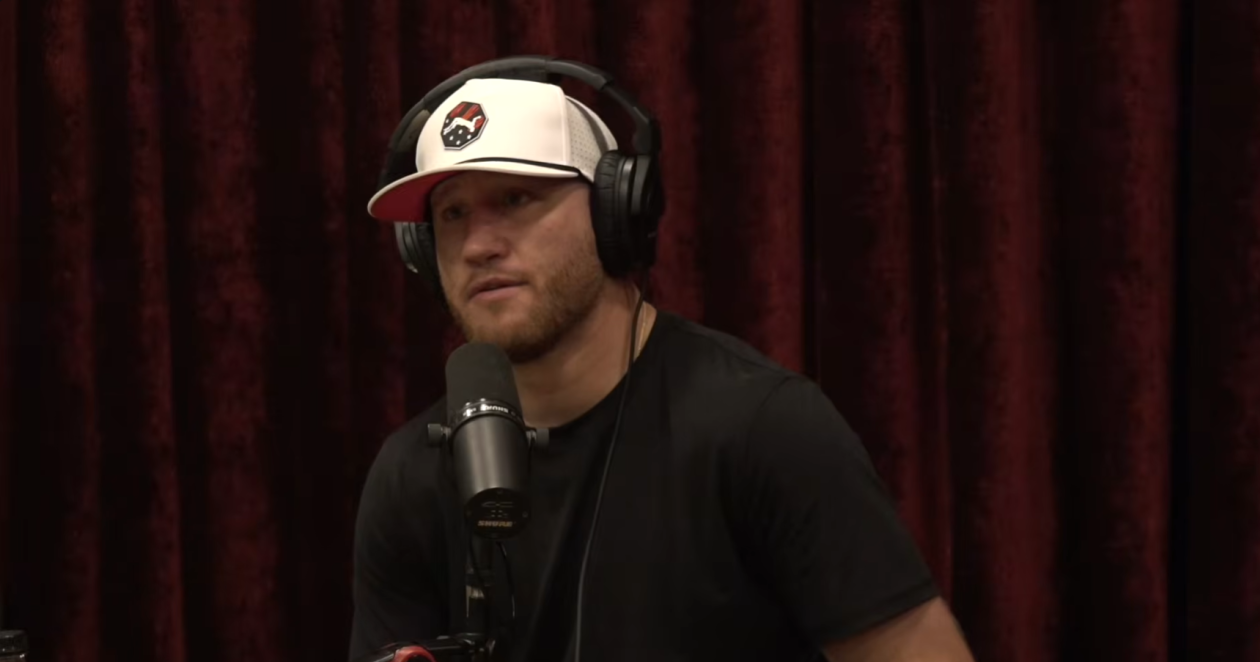
A few days after he stopped Ilia Topuria on the South Lawn of the White House to win the undisputed UFC lightweight title, Justin Gaethje and his head coach Trevor Wittman sat down with Joe Rogan and broke the fight down piece by piece. It is one of the more revealing post-fight conversations in recent memory, because Wittman is unusually good at explaining what actually happened and Gaethje is candid in a way most champions are not.
TL;DR - the 5 biggest takeaways
- He out-thought Topuria, he didn't just out-brawl him. The whole plan was to circle left and never let Topuria set his feet. How he won →
- Getting dropped to the body is what won the fight. The knockdown made Topuria empty the tank chasing a finish that wasn't coming. Why the body shot mattered →
- Gaethje says Topuria quit, and the ref nearly ended it a round early. "I stopped him twice." The quit and the stoppage →
- The Max Holloway loss was the lesson that made this possible. Gaethje says he wasn't mentally there at UFC 300. The Holloway lesson →
- He isn't retiring yet, and Arman Tsarukyan is next in line. No immediate rematch for Topuria. What's next →
This article answers the questions people are searching after that interview: how Gaethje won, whether Topuria quit, the controversial referee call, Topuria's injuries, what is next for both men, and the safety arguments Wittman used the platform to make. If you want the result in isolation or Gaethje's full career context, see our Gaethje title tribute and the complete UFC Freedom 250 guide.
Who won the fight between Justin Gaethje and Ilia Topuria?
Justin Gaethje won, stopping Ilia Topuria by fourth-round TKO to take the undisputed UFC lightweight title. The fight headlined UFC Freedom 250 on the South Lawn of the White House on Sunday, June 14, 2026. It was Topuria's first professional loss and the first undisputed championship of Gaethje's career, won as roughly a six-to-one underdog at the age of 37.
The bout was waved off by Topuria's corner between the fourth and fifth rounds rather than send a badly hurt champion back out, with Topuria's face swelling shut after four rounds of accumulated damage. Gaethje took the microphone afterward and made his case in one line:
I'm the most exciting man that's ever been in this cage.
It is a claim the rating data on Good Fights actually supports: no fighter on the platform has a higher average fight rating.
How did Justin Gaethje beat Ilia Topuria?
Gaethje beat Topuria with a game plan built around movement and footwork, not just his usual volume. The core idea, which he credits almost entirely to coach Trevor Wittman, was to keep circling to Topuria's left and never let the explosive champion plant his feet to load up a power shot.
If you ask him right now which way was Justin moving, he's going to think I was moving right the whole time. But I was moving left the entire time.
Wittman's reasoning is that Topuria is "very front heavy" and most dangerous when he can gather, point, and explode forward. By constantly resetting Topuria's stance onto his back foot, they forced him to reload before every attack.
The detail Wittman lingered on was the jab. They were not jabbing at the center line where Topuria's shoulder roll lives, they were jabbing outside the rear shoulder to keep pushing him onto his back foot, then setting up the right hand behind it. On the clean right hand that landed in the fight, Gaethje's lead foot steps outside Topuria's rear foot first. That foot placement is the whole shot.
Why does Gaethje say getting hurt to the body won the fight?
Gaethje believes the moment Topuria hurt him most, the second-round liver shot that put him on the canvas, is the moment the fight turned in his favor. His read is that the knockdown convinced Topuria the finish was right there, so the champion emptied the tank chasing it, including following Gaethje to the ground rather than staying in his world on the feet.
Him hurting me to my body was one of the main reasons I won.
He pointed out it was not even the first body shot Topuria landed, "that was probably like the fourth or fifth one," and that Topuria, with more career submissions than knockouts, would have been foolish not to chase it. Wittman called it a champion's mistake born of the expectation that he should already be finishing.
Rogan reached for the old Chael Sonnen line to frame it: if you try to win by knockout and fail, you will not win by submission. Topuria spent a roughly two-minute, full-power sprint trying to take Gaethje out and could not. After that, the fight tilted, and the third round saw Topuria visibly slow.
Did Ilia Topuria quit against Justin Gaethje?
According to Gaethje, yes, twice, though it is worth flagging this as the winner's framing rather than an objective fact. The fight officially ended when Topuria's corner stopped it on the stool before the fifth round. Earlier, between rounds, Topuria appeared to tell officials he could not see, which Gaethje read as a fighter looking for a way out.
He quit on the stool. He quit twice. What else do I have to do?
His harsher claim, "I stopped him twice that night," refers to that between-rounds moment plus the final corner stoppage. Topuria himself has not characterized it that way, and a corner stoppage to protect a hurt champion is a normal, responsible call. However you read it, the title changed hands.
Was the Gaethje vs Topuria fight stopped too early or too late?
The fight nearly ended a full round earlier than it did, and both Gaethje and Wittman think referee Marc Goddard made the right call by letting it continue. Between the third and fourth rounds, with Topuria's eye swelling shut, a doctor's stoppage was on the table. Goddard allowed the champion to keep fighting.
Please let it go on. I just wanted a definitive ending.
That was Wittman in the corner, wanting a clean finish rather than a between-rounds doctor's decision on the sport's biggest stage. Gaethje's view was that a fighter does not say he cannot see unless part of him wants out, and that Goddard, an experienced referee, recognized it and did not hand Topuria the exit. The extra round produced the decisive fourth, capped by a knee to the body and elbows that forced the corner stoppage. Critics will argue a champion with a closing eye should have been protected sooner. The counterargument is that Topuria asked to continue and was never defenseless.
What injuries did Ilia Topuria suffer in the fight?
Reports cited in the interview described Topuria leaving with two fractured orbital bones and a broken nose, the kind of cumulative facial damage that recalled Robbie Lawler's work on Rory MacDonald at UFC 189. Gaethje and Wittman discussed orbital and nasal injuries at length, with Wittman noting from personal experience how long broken orbitals and noses take to fully heal.
These details were described as reports rather than confirmed medicals, so treat the specifics as provisional. The broader point both men made is that eye and orbital injuries carry real psychological as well as physical consequences, and that recovery timelines vary. A fighter with facial fractures often needs an extended period without contact before returning.
Why did Justin Gaethje lose to Max Holloway at UFC 300?
Gaethje attributes his knockout loss to Max Holloway not to Holloway's skill but to his own mindset: for the first time in his career, he was not mentally present in the cage. It was a catchweight bout against a fighter from another division, taken "for fun," and the stakes did not trigger his usual fight-or-flight focus.
I was not prepared mentally for the fight when I fought Max Holloway.
He described being able to hear the crowd and even hear his own thoughts during the walkout and the fight, which he took as a warning sign that he was not locked in the way he normally is. He says he could not have beaten Holloway with that mentality, and he calls it the last lesson he needed before this title run. Wittman took his share of the blame for not catching the lapse during camp, a thread of accountability that ran through the whole conversation.
How did Gaethje hide his game plan from Topuria?
Gaethje deliberately published no sparring or mitt-work footage during this camp because he knew Topuria was studying him. With the game plan changing significantly, he did not want to give the champion anything real to prepare for.
I didn't show myself hitting mitts one time this camp. I didn't show myself sparring one time this camp.
He argued Topuria walked in with expectations that "were none of them based in reality, and I controlled that." For a fighter who openly admits he reads every comment and takes everything personally, it is a reminder that the pettiness comes with a genuine strategic edge.
Why doesn't Justin Gaethje drink water during training?
Gaethje says he does not drink water during practice at all, framing it as a mental-toughness habit rather than a hydration strategy. He stays locked in through a session and rehydrates heavily afterward, calling water during training a crutch he refuses.
He made clear this is his personal approach, not advice, and that he hydrates fully outside of training. It connects to a broader theme he and Wittman returned to: getting comfortable being uncomfortable, a trait Gaethje traces to his wrestling background and a small-town upbringing in Safford, Arizona. The discipline is the point, not the deprivation.
What did Justin Gaethje say about his past drug use?
In one of the more personal stretches of the interview, Gaethje spoke openly about a period of serious drug use earlier in his life, before his UFC career took off. He said he had lost several close friends to drugs in his hometown near the Mexican border, and that he studied human services in college partly to understand addiction.
He described the last time he used as waking up in an ambulance around 2016, believing he had nearly died, and deciding never to touch drugs again because, in his words, his parents did not deserve that. He credited his faith and his upbringing for always pulling him back toward something bigger. He framed the whole period as a lesson rather than a regret, consistent with his view that every experience shaped the fighter he became.
What are Trevor Wittman's Onyx gloves, and will the UFC use them?
Trevor Wittman builds fight gear through his company Onyx and used the interview to push for the UFC to adopt his gloves, which are shaped to a natural closed fist with internal strapping. He argues the current UFC gloves are uncomfortable, force a poor hand position, and contribute to broken hands.
Wittman said the UFC reignited the conversation recently after an earlier round of talks, and that the promotion has tried and failed to solve the problem on its own. His pitch is not about eliminating eye pokes, which he believes is impossible because the fingers are exposed, but about fighter comfort, grip strength, and hand protection. Gaethje, who trains in Onyx gloves and says he has not worn hand wraps since 2015, backed him fully. Whether the UFC adopts them remains an open question, but the door is at least reopened.
Is weight cutting dangerous? What Trevor Wittman said
Wittman made a pointed safety argument about weight cutting, suggesting severe dehydration may leave fighters more vulnerable to serious brain injury late in fights. He said his research into boxing deaths found that a striking number occurred in the later rounds, often to fighters who were ahead and not absorbing heavy damage.
His theory, which he was careful to flag as needing proper medical research rather than a settled conclusion, is that training the body to repeatedly shed large amounts of water and then competing hard in a depleted state could be a factor. It is a timely argument given the open question of whether Topuria, a natural featherweight who moved up to lightweight, should stay at 155 pounds. Both men also discussed adding weight classes as a partial fix.
Is Justin Gaethje retiring after winning the title?
Gaethje did not commit to retirement and leaned toward continuing, telling Rogan there is "not something natural in me that feels like it's over." He plans to take the rest of 2026 off to heal, citing a bone edema in his fibula that has bothered him since Christmas, after fighting twice inside six months to reach this point.
Treat his status as undecided rather than confirmed. He has spoken for years about wanting to walk away with his health intact, which makes retirement a real possibility, but as of this interview he had made no formal announcement and signaled he expects to fight again. If he does walk away, doing it as champion on the sport's biggest stage would be a fitting exit.
Who will Justin Gaethje fight next?
Gaethje did not name a definite next opponent, but the name that came up most was Arman Tsarukyan, widely seen as the top contender at lightweight. Charles Oliveira also surfaced as a possibility, with talk of a fight combining the BMF belt and the lightweight title.
Gaethje said he wants to be compensated for what he has delivered before committing to anything, pointing to his run of marquee fights at UFC 300, UFC 324, and the White House card. With a year-end break planned, any next fight is likely in 2027. He was clear that he intends to be selective rather than rush back.
Will Ilia Topuria get an immediate rematch?
Gaethje said no, Topuria does not get an immediate rematch. His reasoning was blunt: "He quit on the stool. He quit twice. What else do I have to do?" He suggested Topuria should rebuild with a fight against a contender like Paddy Pimblett before earning another title shot.
This is Gaethje's opinion rather than a matchmaking decision, and the UFC may see the box office differently given how big a rematch could be. But the champion's stated position is that Topuria has to win his way back rather than walk straight into a second attempt.
Who is Arman Tsarukyan and what was the million-dollar bet?
Arman Tsarukyan is a top lightweight contender and, per the interview, the man who reportedly bet a large sum on Gaethje to beat Topuria and won big. Gaethje said Tsarukyan offered to buy him a truck out of the winnings, an offer Gaethje declined because the two never shook on it.
Beyond the bet, Tsarukyan is the most logical next challenger for the title, which makes the exchange more than a fun aside. If Gaethje returns in 2027, a fight with Tsarukyan is one of the most likely options the division offers.
The throughline of the whole conversation is accountability. Gaethje credits his parents, his faith, and a wrestling background for a mindset that treats every loss as his own fault and every fight as a war to be survived. Wittman credits the same traits for making him coachable. Between them they turned a heavy underdog into a champion, and then explained exactly how, which is rarer than the win itself.
Justin Gaethje has the highest average fight rating of any fighter on Good Fights. See his career ranked by how fans rated it, and rate his fights yourself, on Good Fights. For more on the man he beat, read Ilia Topuria's undefeated run, and for the night itself, the UFC Freedom 250 guide. Never miss a Good Fight.